
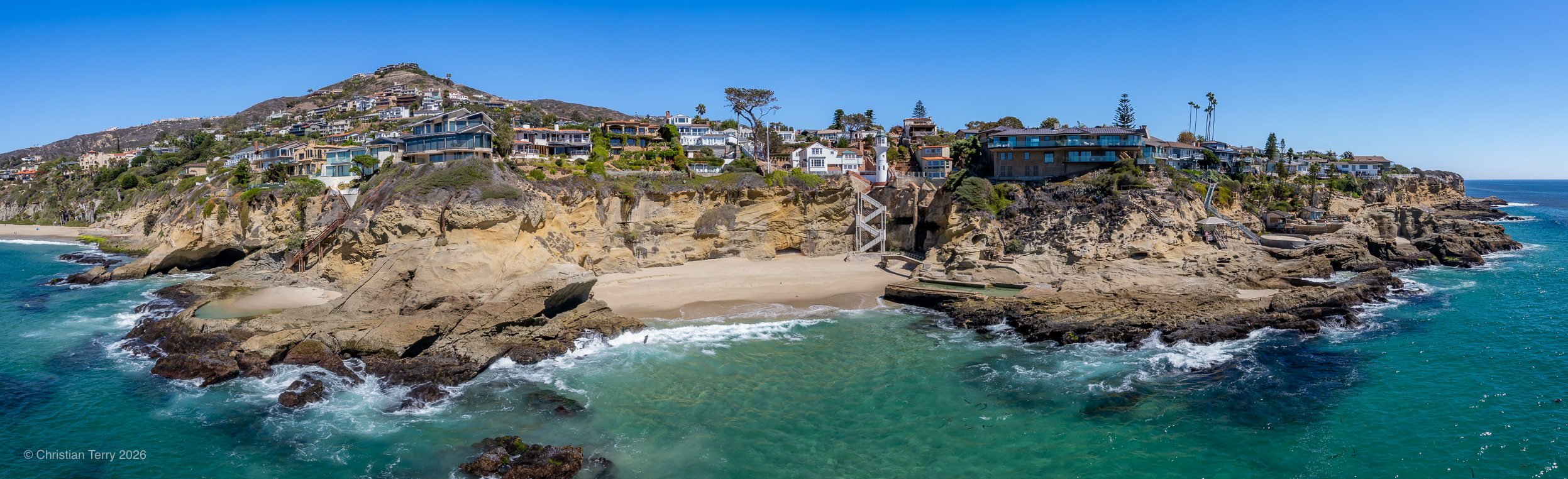
Laguna Beach site rehabilitation with existing lighthouse, a private staircase to beach, and one of the few salt water pools built in the 1930s that is filled twice a day by the Pacific Ocean tides. The image was captured by drone to help better understand the site and its relationship to neighbors, topography, and the coastal environment.
Terry Design, Inc. uses UAVs (unmanned aerial vehicles), more commonly known as drones, across our landscape architecture projects throughout Southern California. Our work spans communities such as Calabasas, Pacific Palisades, and West Los Angeles, across the Palos Verdes Peninsula, down through coastal cities like Newport Beach and Laguna Beach, and inland to Orange, Fullerton, and Yorba Linda. We have also provided drone services on the East Coast, including projects in New York, Connecticut, and Vermont. While each project is unique, drones consistently play a valuable role from initial site analysis through construction and final documentation.
The first step in any new project is obtaining a detailed survey that documents topography, existing structures, architectural elements, and mature vegetation. We then visit the site to verify these conditions in person. However, on complex properties—especially those with varied terrain or significant view opportunities—this ground-level understanding only tells part of the story. As licensed and insured drone operators, we are able to capture aerial imagery early in the process, giving us a more complete perspective of the site. This includes relationships to neighboring properties, existing utilities such as poles and towers, tree canopies, and potential views from future developed areas.
Drone technology becomes even more valuable during the conceptual and planning phases. Aerial imagery allows us to study spatial relationships that are difficult to fully grasp from the ground, such as how proposed design elements will relate to grading, vegetation, and surrounding context. High-resolution photos and video from multiple vantage points provide clear visual references that support design decisions and improve communication with clients, consultants, and permitting agencies. This broader perspective often reveals both opportunities and constraints that might otherwise go unnoticed, leading to more thoughtful and efficient design solutions.
As projects move into design development, drone data can be used to generate photogrammetric models and orthomosaic maps, creating an accurate and scalable base for planning. These tools strengthen coordination between disciplines—including civil engineering, architecture, and arboriculture—helping ensure that grading, drainage, and planting strategies are aligned. For clients, this results in a clearer understanding of the project and helps minimize unexpected challenges during construction. Drone imagery can also be incorporated into visual simulations, allowing stakeholders to better envision views, sightlines, and the overall character of the finished space.
During construction, drones provide a safe and efficient way to monitor progress and document site conditions. Regular aerial updates help track milestones, confirm that work aligns with the design intent, and identify potential issues early—before they become costly problems. This is especially beneficial on larger or more complex sites where access may be limited or conditions evolve quickly. For clients, these updates offer transparency and confidence, supported by clear visual records that can be shared with the broader project team.
Even after construction is complete, photos and data captured by drones continues to add value. They allow us to document finished projects with compelling imagery, capturing the full spatial experience of the design. Over time, repeat flights can support ongoing site evaluation, including monitoring plant health, irrigation performance, drainage patterns, and overall landscape maturity. This enables more proactive maintenance and helps ensure that the landscape continues to perform as intended.
From initial concept through long-term stewardship, drone technology enhances our ability to analyze, design, communicate, and manage landscapes with greater clarity and precision. For our clients, this translates into better-informed decisions, smoother project delivery, and a deeper understanding of their investment at every stage.
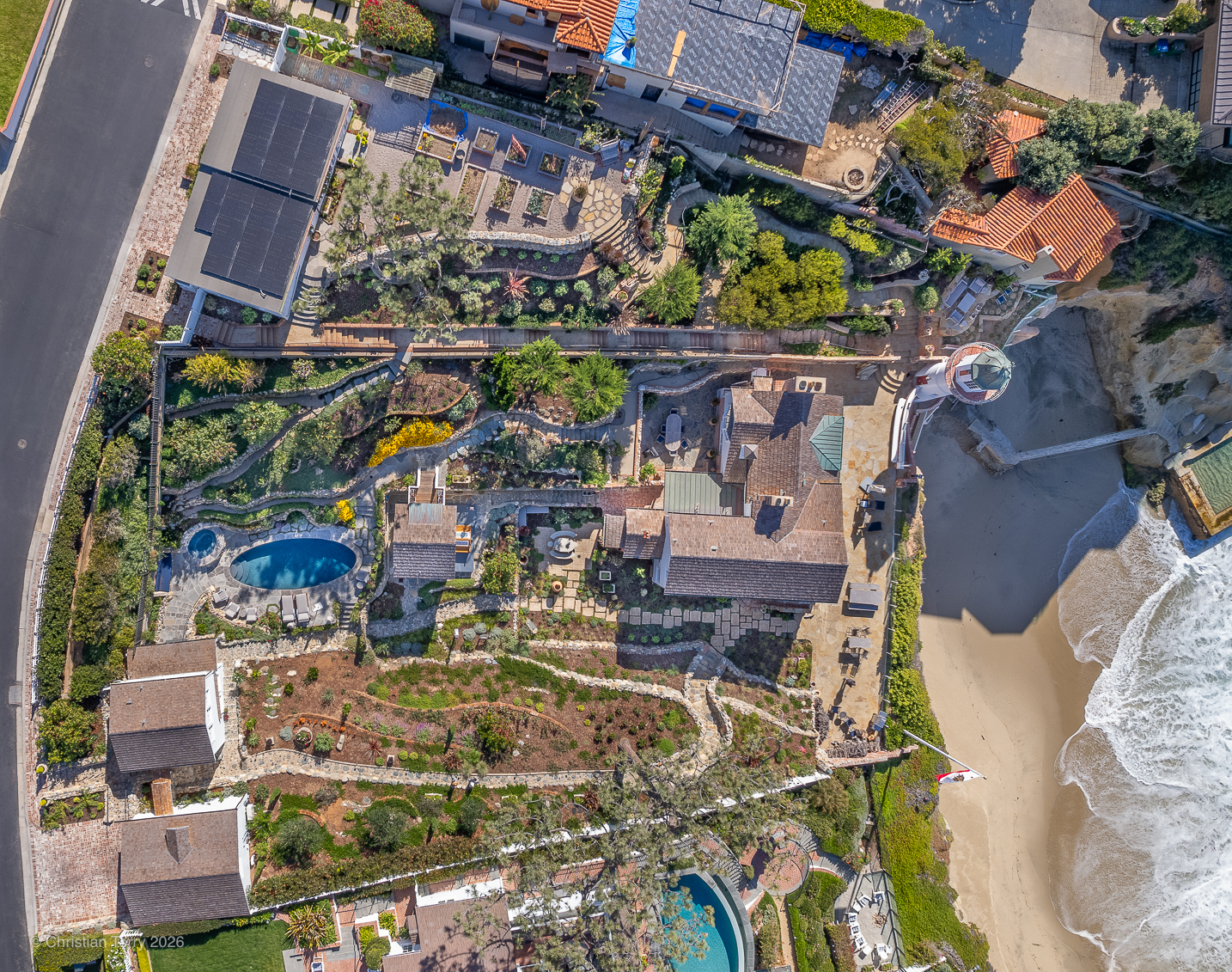
Laguna Beach site captured by Terry Design, Inc. by drone at project completion. This image shows how the site comes together, including its historic buildings, restored features, stone pathways and stairs, plus new additions like the oval swimming pool, raised vegetable garden beds, and the overall planting design.
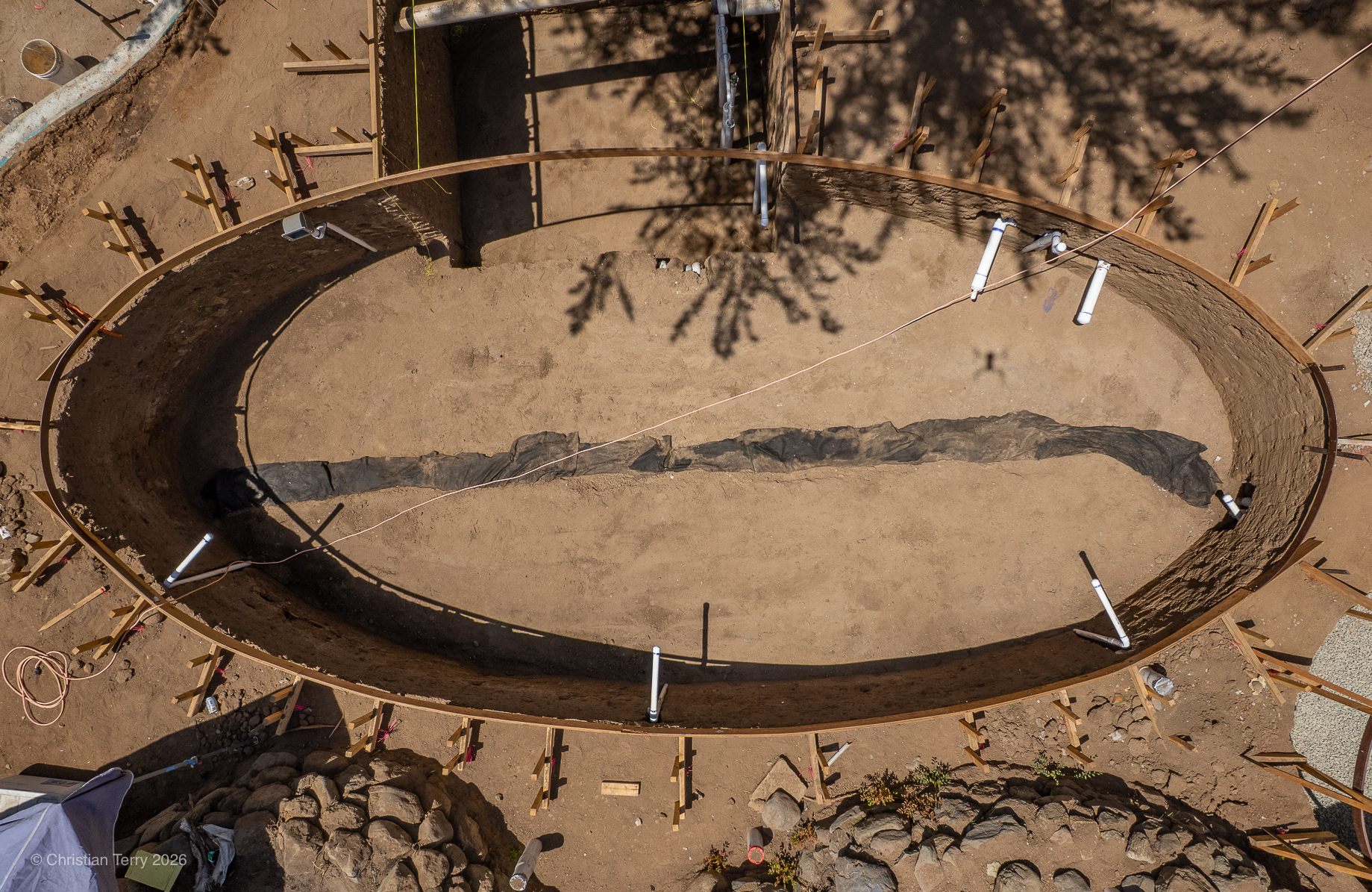
The formwork for the oval swimming pool is perfectly captured by drone at our Laguna Beach site
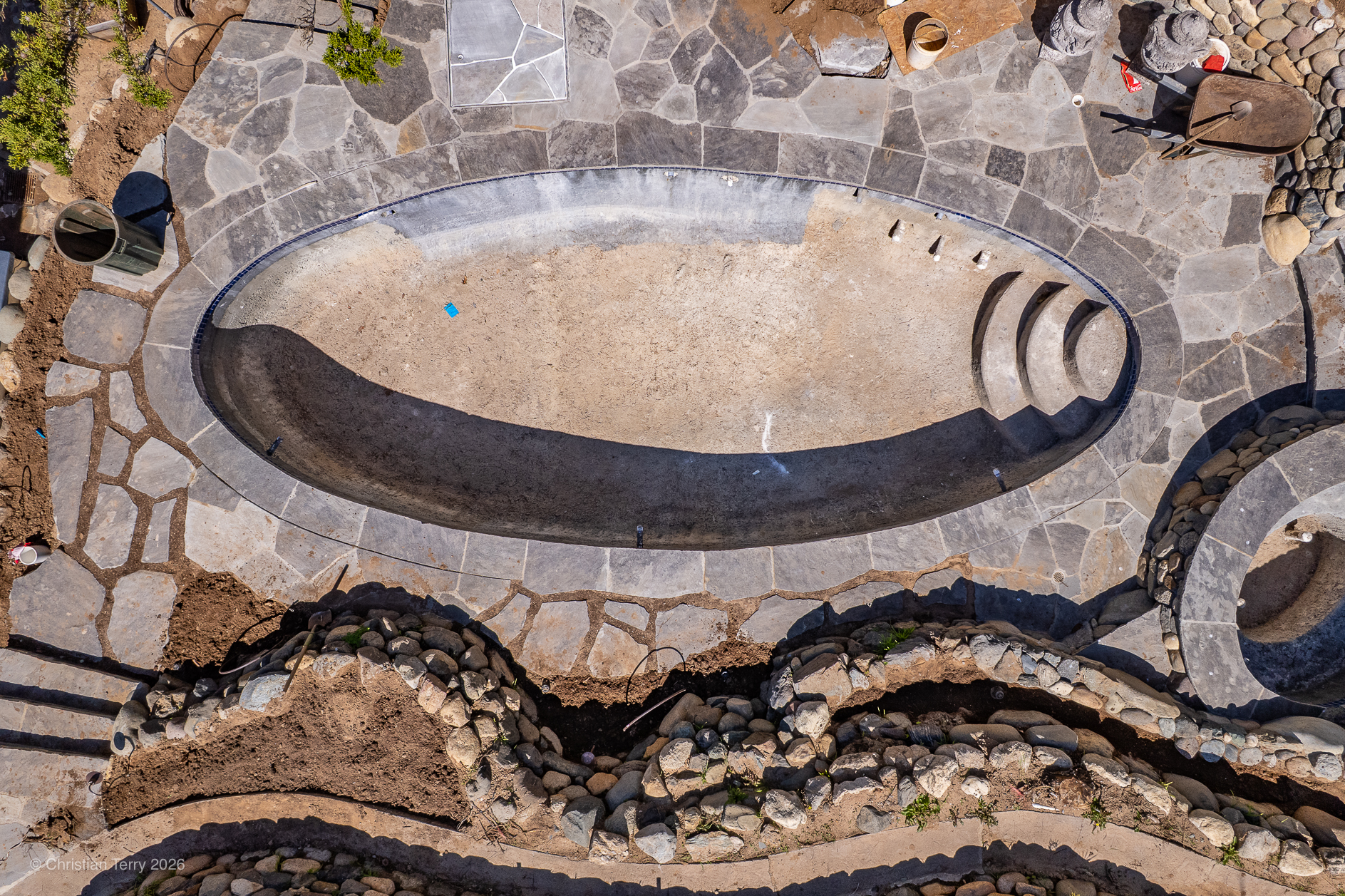
The final masonry and surrounding stone walls for the oval swimming pool at the Laguna Beach site just prior to completion provides visual confirmation that the design intent was fully realized.